Version 0.x, under review. SEVEN-G is currently at version 0.x. The content is operational and may be used, adapted and redistributed under the project licence (CC BY 4.0 for content and MIT for code), crediting the author and indicating changes. Documents and tools are still being reviewed: feedback and proposals for improvement are welcome.
Legal notice and disclaimer. SEVEN-G is a reference methodological framework provided "as is" and for information purposes only. It does not constitute legal, regulatory, financial or professional advice, nor does it guarantee compliance with any law or standard. References to general regulation (such as the EU AI Act, the GDPR, DORA or NIS2), to technical standards and to regulation specific to each sector or jurisdiction may be incomplete, may not apply to a particular case or may become out of date as a result of regulatory changes, interpretations or supervisory positions after their consultation date. Each organisation that uses SEVEN-G is solely responsible for identifying the regulation that applies to it, verifying that it is current and certifying its own regulatory compliance, with the appropriate qualified advice. This methodology is a generic, free aid shared with the community so that nobody has to start from scratch; each person or organisation can and should adapt it to its own use. It must not be inferred that its legally sensitive parts have been reviewed by legal counsel: those reviews, for each company or sector, are the ultimate responsibility of the company, consultant or organisation that uses it. Although every effort is made to keep it up to date, some regulation may have changed without being reflected here. To the fullest extent permitted by law, the author accepts no responsibility whatsoever for the effects of its application in any organisation or for its full applicability. The methodology does not grant certification of any kind. The author accepts no liability for any use made of this content or for any decisions taken on the basis of it. The data, figures, companies and cases in the examples are fictitious or illustrative.
00Quick start
SEVEN-G (Seven-phase Enterprise Value & Governance) is a complete method, free of charge and modifiable, that lets a company, a consultancy or an independent professional implement, govern and measure an organisation's artificial intelligence —enterprise self-consulting supported by AI— and answer, with evidence, whether it is transforming itself or just becoming more efficient. This section takes about fifteen minutes to read and serves a single purpose: deciding whether it is worth reading on.
What it does, in four ideas
- It organises the company's AI as a portfolio, not as a list of projects: each use case is registered, and its phase, its cost, the value expected from it and its accountable owner are known.
- It places decision gates between phases. Moving forward requires results and verified documentation; otherwise the use case iterates, pivots or stops, and the reason is recorded.
- It separates who decides, who builds and who controls, and translates regulation (EU AI Act, GDPR, DORA, NIS2, ISO/IEC 42001) into specific phases, roles and evidence.
- It measures value in money and with a status —validated, declared or estimated— and tells the board, with eight observable signals, whether the company is transforming itself or just becoming more efficient.
What it is compared with the standards. SEVEN-G is an operating methodology for transforming the company with AI: it decides where to invest, governs each use case and measures value with evidence. Standards and regulation —ISO/IEC 42001, ISO/IEC 38507, ISO/IEC 23894, ISO/IEC 42005, the NIST AI RMF or the EU AI Act— say what must exist: a management system, responsibilities of the governing body, a risk process, impact assessments, legal obligations. SEVEN-G is the operating layer that makes it work, case by case and portfolio by portfolio, with investment and value discipline: who decides at each gate, with what evidence, what it costs and what it yields. It is not an alternative to ISO/IEC 42001 nor equivalent to a certification: its crosswalk (document 34, section 9.1) says which requirement it covers, which it covers in part and which needs an external control.
What you get, at no cost
SEVEN-G is not a brochure that ends in a sales proposal: the working material is here, in full. The documents explain the method; the templates are the deliverables, ready to be filled in; the tools are applications that work with each company's data. Everything can be used as it is, trimmed, extended, renamed or built into the methodology that the company or its consultancy already uses, with a single condition: credit the author and indicate the changes.
Why it matters. Most of the cost of bringing order to AI lies not in understanding what has to be done, but in producing the instruments: policies, minutes, registers, checklists, dashboards. Starting from complete material, which can be modified without asking for permission, lets the effort go into deciding rather than into formatting, and makes it possible to check in an afternoon —with the sample data— whether the approach fits the company before committing anyone.
What you actually get, for anyone who wants to see it before reading
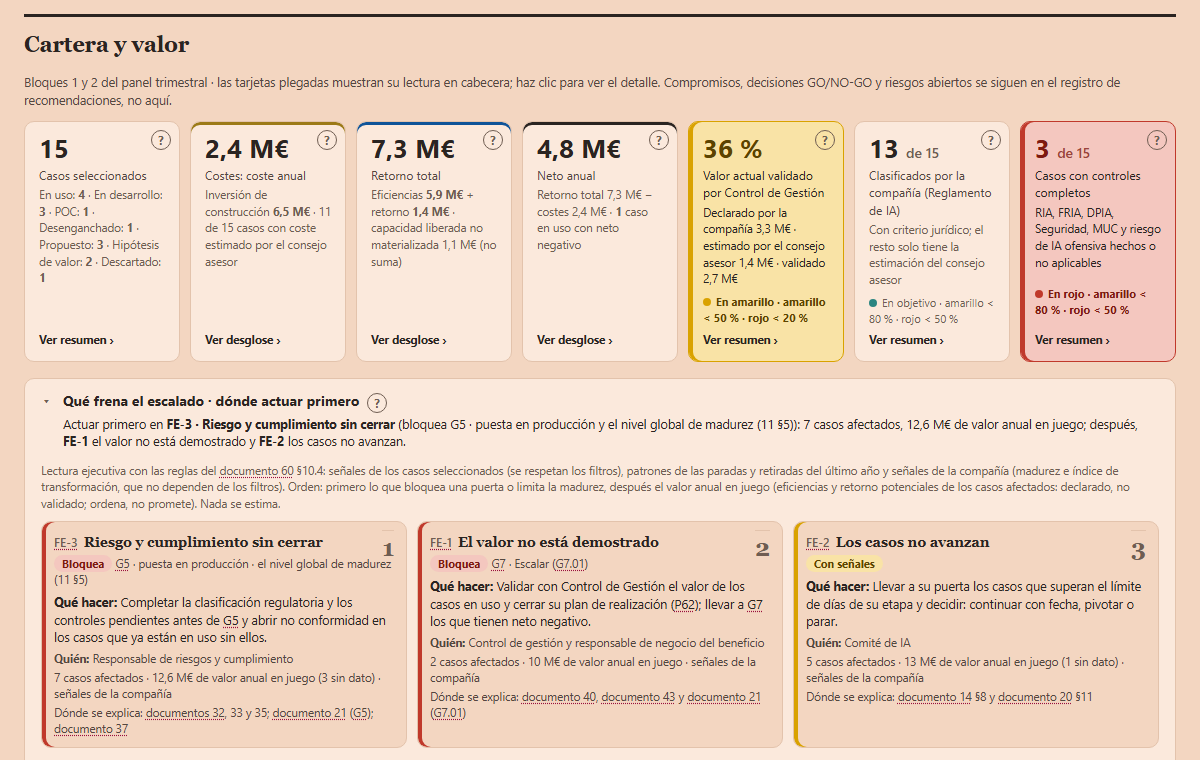
Two quick views, with the fictitious sample data: the AI use case portfolio read as a funnel (which phase each use case reaches, how many are lost at each one and why) and the board dashboard generated from that same register (cost, return and net of the portfolio). This is what using SEVEN-G leads to: from one use case's register entry to a board decision backed by evidence.
Is it useful? (for your company, or for the consultancy or professional advising it)
| It is probably useful if… | It is probably not useful, or not yet, if… |
|---|---|
| You already have AI use cases —pilots, generative assistants, models, agents— and nobody can say with evidence how much they cost, how much they contribute and who is accountable for each one. | You are looking for a technical guide to build models or choose technology. SEVEN-G governs and measures. Building software with AI is a different problem: SPAD, an independent method, solves it, and document 53 is the only bridge between the two. |
| The board or senior management ask about AI and receive an inventory of technical projects instead of business decisions. | You are looking for a certification or a seal. There is none: the declaration of application is a self-declaration that can be verified by audit. |
| There are many pilots and few use cases in production, and no rule for stopping what does not work. | You expect legal advice or a guarantee of compliance. The framework maps obligations to evidence, but each company is responsible for its own compliance. |
| You have to demonstrate compliance with evidence rather than statements. | You only have one or two trials with no budget and no intention of taking them to production. Start with the acceptable use policy (document 31) and the AI system inventory (T02), and come back when there is a portfolio to govern. |
| You are a medium-sized company with no AI team: the Lite scope works with the executive committee, one part-time person and an external auditor. | Nobody in management is going to own the decisions. The framework requires a sponsor for each use case and a real ability to stop; without that, it only produces documents. |
| You are a consultant or an in-house lead and need a complete method that you can adapt and apply with your own way of working, citing the source (document 91). |
What it asks in return. It costs no money, but it does take discipline: someone to drive it, a use case register kept up to date and decisions taken with the evidence on the table. What is non-negotiable fits in fourteen rules, the core (document 01, section 14.1); everything else is applied in proportion to the risk and materiality of each use case (principle 11, document 94). Adoption can be modular —starting only with the register, with the decision gates, with value measurement or with the board dashboard— and be extended later. The implementation guide (document 90) proposes a 90-day plan and a minimum path for medium-sized companies; document 96 and its tool, the implementation journey (T23), say where to start according to the AI and the governance the company already has.
Where to go next, depending on who you are
| If you are… | Continue with… |
|---|---|
| A member of the board or of senior management | Section 5 of this page (transforming or just becoming more efficient), the board conversation guide and the sample board dashboard (T17). |
| An AI, data or technology lead | The foundational methodology, the phase manuals and the use case register (T01). |
| Risk, compliance, data protection or audit | The regulatory mapping, the AI risk methodology and the AI audit framework. |
| Finance or management control | The value measurement rules and the value and cost calculator (T11). |
| A consultant or the person in charge of implementing the framework | The implementation guide, the guide for consultants and the application cases. |
The rest of this page develops the above in detail: what SEVEN-G means and how it is followed (section 1), the problem it solves (2), what it helps with (3), how it is built (4), how it tells transformation from efficiency (5) and the rules it uses to measure value (6).
01What SEVEN-G means
SEVEN-G means Seven-phase Enterprise Value & Governance: one enabling phase 0 and seven value phases (1-7), with governance applied across all of them.
The intent of the framework is to enable, with AI support, a model of enterprise self-consulting: any company, consultancy or independent professional should be able to use SEVEN-G to implement, govern, measure, adapt, extend and improve an AI system without depending on a closed third-party interpretation.
SEVEN-G is designed to be compatible with existing governance structures, with in-house or external consulting support, and with other frameworks the company may already use. It does not require replacing them: it allows organisations to integrate them, structure their contributions and convert them into traceable decisions based on shared value, risk, compliance and measurement criteria.
This use and adaptation are enabled by the project's content license (CC BY 4.0), with an explicit condition: always provide visible attribution to Fernando García Varela, and indicate whether changes were made.
SEVEN-G enables an organisation to implement, govern and measure artificial intelligence with the same rigour it applies to its finances, its risks or its regulatory compliance, and enables its decision and governance bodies to answer, with evidence, a question that almost no one can answer today:
Is the company transforming itself with AI, or is it just becoming more efficient?
Both are legitimate. The problem arises when they are confused: when a portfolio of automations is presented as transformation, when savings are declared that never materialise, or when the bets that could change the business are blocked using the same return criteria as a cost-cutting project.
The practical goal is for boards, senior management and control bodies to understand and measure the contribution of enterprise intelligence in their company, understand and contain its risks, and decide with portfolio discipline which use cases deserve investment to improve efficiency, transform capabilities and create measurable impact on P&L.
Ownership and reuse. The intellectual property of the SEVEN-G methodology — its documents, templates, criteria and tools — belongs to its author, Fernando García Varela. The framework is offered as an open reference for use, adaptation and learning, not as a closed commercial product or a version released to clients or markets: any organisation may reuse and adapt it, but that use is subject to the project's content and code licence (CC BY 4.0 for content, MIT for code; document 93), which requires attribution and an indication of any changes made. Using SEVEN-G, including adapting it under that licence, does not transfer ownership of the methodology or confer exclusivity or any ownership right over the base methodology on any client, supplier or third party, except under a specific written agreement covering proprietary developments.
SEVEN-G provides four things:
- A map of where and with what ambition to use AI: nine spheres of impact and three ambition levels (Optimise, Augment, Transform).
- A controlled lifecycle for each use case, with phases, auditable decision gates (gates) and a real ability to stop or retire.
- A governance system with separate roles, clear responsibilities and mapped regulatory compliance (EU AI Act, ISO/IEC 42001, GDPR, DORA and sector-specific regulation).
- A measurement system with explicit rules that separate validated value from declared value, efficiency from growth, and evidenced transformation from announced transformation.
Adoption can be full or modular: a company may deploy the entire framework or start with a specific component (for example measurement, gates, regulatory inventory or oversight dashboard) and then expand without losing methodological coherence.
All of this comes with templates, audit criteria and tools —including an AI dashboard for the board— that allow it to be applied in any sector.
How SEVEN-G is used, at a glance
Before the detail, the route. Each use case moves through phases and, at the end of each one, a decision gate checks the result and the documentation at the same time (dual validation). If what the documents require is not met, the use case does not move forward: it iterates (at most twice before the decision is escalated), pivots to a new hypothesis or stops, and the reason is recorded. Once past go-live (G5), the use case enters an operation loop with continuous monitoring and periodic continuity reviews (R6), until gate G7 decides to scale it, iterate it or retire it.
The following map brings together in a single view how the framework is followed: at the top, the corporate cycle in which the company decides and oversees; in the centre, the lifecycle of each use case, with its funnel stage, its phase, its decision gate and the templates, documents and tools used in it; at the bottom, the cross-cutting governance that accompanies every phase. Each element links to the document, section, template or tool that develops it.
Why it matters. SEVEN-G has many pieces, and a first-time user needs to know what applies at each moment and where to find it. The map answers three practical questions —which phase a use case is in, what must be provided to pass its gate and with which template or tool— and serves as a starting point to navigate the library without reading all of it.
02The problem it solves
In most organisations, AI grows faster than their capacity to govern it. The symptoms are recognisable in any sector:
| Symptom | Consequence |
|---|---|
| The board receives AI as an inventory of technical projects, not as business decisions. | It cannot prioritise, cannot make demands and cannot exercise its oversight responsibility. |
| There are many pilots and few use cases in production. Pilots are neither closed nor scaled. | Recurring cost with no return and a loss of internal credibility. |
| Value is declared, not validated. Released hours are added up as savings even though no one has realised them. | Aggregate figures that do not withstand an audit and poorly grounded investment decisions. |
| No one can stop a project. There are no formal criteria for iterating, pivoting or retiring. | Portfolios that only grow and concentrate risk. |
| Accountability is fragmented across technology, business, risk and compliance. Whoever builds also approves. | Weak controls and a lack of accountability. |
| Regulatory and security risk is addressed late: classification under the AI Act, impact assessments, suppliers, agents with excessive permissions, AI used by attackers. | Legal, reputational and operational exposure. |
| The word "transformation" is used to describe use cases that do the same thing at lower cost. | The organisation believes it is transforming when it is only becoming more efficient, and fails to take the decisions that real transformation would require. |
SEVEN-G starts from a premise: these problems are not technological; they are problems of governance and measurement. That is why the framework is aimed both at the teams that build and at those who decide and oversee.
03What SEVEN-G helps with
3.1 Implementing AI
- Identify opportunities from the business, not from the technology available.
- Formulate each use case as a falsifiable value hypothesis: baseline, target, attribution method and success threshold defined before investing.
- Follow a lifecycle with known phases and deliverables, from defining the context through to operation, scaling or retirement.
- Decide with explicit criteria at each gate: proceed, proceed with conditions, iterate, pivot or stop.
- Move from pilot to production with requirements for operation, human oversight, monitoring and reversibility.
- Address generative AI and agents with specific controls: evaluations, agent identity and permissions, intent-based access control, a kill switch and human validation for sensitive actions.
3.2 Governing AI
- Establish who decides, who builds and who controls, with segregation of duties: whoever builds does not audit, and no one approves their own work.
- Maintain an AI system inventory with each system's regulatory classification, its assessments (data protection, fundamental rights, security) and its owner.
- Integrate AI into existing bodies —board, risk committee, internal audit, compliance— instead of creating a parallel governance structure.
- Translate regulation into concrete controls. SEVEN-G does not embed any specific regulation: it maps each obligation to a phase, a role and a piece of evidence, so that the framework survives regulatory change.
- Manage AI suppliers: build, buy or partner; technological dependency; contracts that protect data and intellectual property; obligations relating to critical third parties.
- Treat deviations as nonconformities, with containment, root cause, corrective action and re-audit.
3.3 Measuring implementation and value
- Measure each use case in money, with a formula and a validation status: validated (by management control or audit), declared (by the business area) or estimated (by the AI Committee, the board or the assessment team).
- Separate efficiencies (lower cost) from return (revenue, retention, price, margin), and both from recurring cost.
- Apply rules that prevent inflated figures (section 6).
- Measure the agility of the decision-making system: time from idea to approval and to production, by risk level and ambition level.
- Measure maturity with observable evidence, not self-assessments.
- Keep a register of recommendations and decisions with persistent identifiers, owners, dates and evidence, so that follow-up does not depend on people's memory of meetings.
3.4 Knowing whether the company is transforming or just becoming more efficient
This is the framework's most distinctive contribution and is developed in section 5.
04How the framework is built
SEVEN-G is organised into two levels of governance —the company level and the level of each use case— and four components used at both levels.
4.1 Component A · Impact map: nine spheres and three ambition levels
A board does not decide on use cases; it decides on risk, opportunity, competitive advantage and accountability. The impact map makes it possible to talk about AI without talking about technology.
Why it matters. Without an impact map, the portfolio fills up with technically attractive but strategically unstructured use cases. The map forces explicit choices on where value should be created, what ambition is acceptable and what should not be funded.
Nine spheres, valid for any sector:
Where value is created01 Customer · 02 Product and service · 03 People · 04 Operations
Enablers05 Data · 06 Knowledge · 07 Decision. This is where the uncomfortable questions arise.
Boundaries08 Regulation, ethics and accountability. Assessed in terms of compliance, anticipation and ethical leadership.
Meta-sphere09 AI governance. Connects the other eight with the formality of finance, risk or compliance.
| Type | Sphere | Reference question for the board |
|---|---|---|
| Where value is created | 01 · Customer | If a competitor knows our customers better because it uses AI better, how long will it take us to lose relevance? |
| 02 · Product and service | Are we using AI to protect the current product or to build the next one? | |
| 03 · People | Does AI replace, augment or reorganise people's work? | |
| 04 · Operations | Which processes have a demonstrable short-term return and which require a complete redesign? | |
| Enablers | 05 · Data | Do we know what data we have, who is accountable for its quality and whether we can legally use it for AI? |
| 06 · Knowledge | How much critical knowledge depends on a few people and is not available to the organisation? | |
| 07 · Decision | What does AI decide on its own, what requires human validation and what is never delegated? | |
| Boundaries | 08 · Regulation, ethics and accountability | Do we govern proactively, or do we wait for the regulator to force us? |
| Meta-sphere | 09 · AI governance | Does AI have corporate governance with the same formality as finance, risk or compliance? |
Three ambition levels, which are not a ladder but three types of bet with different cost, risk, timeframe and organisational resistance:
| Level | What it means | Where the value lies | Who should decide |
|---|---|---|---|
| Optimise | Doing the same thing faster, cheaper or with fewer errors. It does not change what is done or who does it. | Mainly in efficiencies (avoided cost). | Management of the business area, within the portfolio framework. |
| Augment | People do what they could not do before. The role changes, not the business. | Combined: cost and performance (productivity, quality, conversion). | Senior management, with visibility for the AI Committee. |
| Transform | Changes what is offered, how the company competes or how it is organised. | Mainly in return (revenue, new services, competitive position) and in changes to the operating model. | Explicit decision by the board or senior management. |
Spheres 08 and 09 are not assessed on these three levels, because they do not generate value in themselves: sphere 08 is assessed on Compliance, Anticipation and Ethical leadership, and sphere 09 on Structure, Balance between speed and control and Supplier ecosystem (grades Absent, Basic, Systematic and Advanced; document 10).
4.2 Company level · Corporate cycle
This is the cycle in which the board and senior management perform their role. It runs annually, with quarterly oversight:
Why it matters. Without a corporate cycle, AI decisions remain isolated projects. This cycle turns AI into a management discipline: it sets direction, allocates capital, oversees execution and requires annual evidence-based review.
| Stage | Question it answers | Main output |
|---|---|---|
| Diagnosis (C1) | Where are we? | Maturity by dimension with evidence, current sphere map, efficiency–transformation profile, AI system inventory. |
| Direction (C2) | Where do we want to play, and with what ambition and risk appetite? | The company's AI thesis, ambition level per sphere, risk appetite, principles and corporate policy. |
| Portfolio (C3) | Which use cases do we fund, which do we stop, and in what balance? | Prioritised portfolio with a balance across ambition levels, budget and owners. |
| Oversight (C4) | Is what was decided being delivered? | Board dashboard, register of recommendations, relevant gate decisions, incidents and nonconformities. |
| Review (C5) | Have we made progress? Are we transforming? | Annual review of maturity, the transformation index and the AI thesis. |
A first implementation can concentrate C1 to C3 into ninety days: maturity diagnosis (month 1), map of risks and opportunities with owners and economic impact (month 2), and a governance structure with gates, metrics and reporting cadence (month 3).
4.3 Use case level · Lifecycle with decision gates
Each AI use case goes through eight phases. Phase 0 is enabling: without it, the use case is not authorised. The seven phases that follow take the use case from opportunity to demonstrated value, and the G in SEVEN-G expresses that governance is present in all of them.
Why it matters. The lifecycle prevents two expensive errors: moving to production without evidence and keeping value-poor use cases alive by inertia. Decision gates introduce investment discipline and make timely stopping possible.
| Phase | Name | Objective | Main evidence |
|---|---|---|---|
| 0 | Context and constraints | Set strategic objectives and regulatory, ethical and budgetary constraints, and assign roles. | Use case charter, context statement, role assignment record. |
| 1 | Opportunity discovery | Identify opportunities from the business and discard those that do not require AI. | Opportunity portfolio, screening notes, proposed sphere and ambition level. |
| 2 | Value hypothesis | Formulate a measurable and falsifiable hypothesis. If the hypothesis cannot fail, it is not valid. | Value hypothesis canvas, baseline metrics, attribution method. |
| 3 | Feasibility and risk | Assess technical, economic, data and risk feasibility. This is the main stop gate. | Feasibility assessment, regulatory classification, risk matrix and register, mitigation plan. |
| 4 | Solution design | Design the architecture, data and model lineage, human oversight, controls and reversibility. | Architecture record, data and model lineage, governance design, rollback plan. |
| 5 | Delivery and validation | Demonstrate value under real conditions. Theoretical results are not enough. | Delivery report, validation results, updated risk register. |
| 6 | Operation and governance | Operate stably, watch for degradation, respond to incidents. | Operations manual, monitoring and alerting configuration, incident response plan. |
| 7 | Evolution or retirement | Scale, iterate or retire based on the evidence of value and risk. | Value realisation tracking, scaling or retirement decision record. |
The use case portfolio as a funnel
SEVEN-G looks at the company's set of AI use cases with the same approach as a traditional sales funnel: to reach its final stage —in production— every use case has to go through a mandatory set of states, and in each of them it can move forward, wait or drop out. Registering a use case is the equivalent of logging an opportunity in a CRM: from that moment on it is known which stage it is in, how long it has been there, what cost, efficiencies and return are expected and, if it leaves the funnel, why it left and what was learned.
The funnel stages group the lifecycle phases: Proposed (phases 0 and 1), Value hypothesis (phase 2), Proof of concept (phase 3) and In development (phases 4 and 5). The funnel holds only the use cases in progress. Those In use (phases 6 and 7) have already gone through it, and those that are disengaged after having been in use are tracked separately, with their reason.
Why it matters. The funnel turns the portfolio into something the AI committee and the board can read at a glance: how many use cases come in, where they get stuck, how many reach production, what value they produce and what is learned from those that do not get there. It is the view shared by the use case register (T01) and the board dashboard (T17).
Decision gate rules
- Each gate is passed through dual validation: tangible results and verified documentation.
- Possible outcomes: Proceed, Proceed with conditions, Iterate, Pivot or Stop. In phase 7: Scale, Iterate or Retire.
- If any mandatory evidence is missing, the use case does not proceed. Partial compliance only allows iterating or proceeding with explicit conditions, a deadline and an owner.
- No one approves their own work. Documentation produced after the fact in order to pass a gate invalidates the gate.
- A well-founded decision to stop is a valid outcome of the method: avoiding a bad investment also creates value.
Two application intensities
| Intensity | When it applies | What changes |
|---|---|---|
| Express | Small use cases for internal use, reversible, with autonomy A0 or A1, without sensitive data and below the C2 Express threshold, with eligibility confirmed by the risk function. | The same gates with a reduced list of criteria —all security, compliance and human oversight criteria remain—, a living record instead of templates and an annual review; G3 is still separate. |
| Lite | Low-risk use cases, internal use, no decisions about people and no customer exposure, limited investment. | Grouped gates, simplified templates, decision by the sponsor with a record and verification by the AI Office. |
| Enterprise | Systems that are high-risk under regulation, direct exposure to customers or people, automated decisions, agents with the ability to act, regulated environments or significant investment. | All gates and evidence, independent audit, visibility for the AI Committee and, where appropriate, for the board. |
Intensity is decided use case by use case. Separately, each company chooses its implementation scope, also Lite or Enterprise, which determines how it organises its bodies and verification: with a Lite scope, a medium-sized, unregulated company governs AI with its executive committee, an AI Office of one part-time person and an external auditor, and any use case that meets an Enterprise criterion is still managed with Enterprise intensity. The implementation guide (document 90, section 2) explains how the scope is chosen and what the minimum path in a Lite scope is.
4.4 Component B · Governance system
Why it matters. If decision, build and control duties are not separated, the framework loses credibility and operational and regulatory risk increases. A clear governance system speeds up sound decisions and reduces the cost of correcting errors.
Use case roles, with segregation of duties:
| Function | Role | Responsibility |
|---|---|---|
| Decides | AI Sponsor | Accountable for value and authorises the investment. |
| Builds | AI Product Owner | Accountable for the value hypothesis and adoption. |
| AI Technical Owner | Accountable for the solution, the data and the models. | |
| AI Operations Owner | Accountable for stability, monitoring and incidents. | |
| Controls | AI Risk Owner | Accountable for the assessment and monitoring of risk and compliance. |
| AI Auditor | Verifies evidence at the gates and closes nonconformities. Independent of the team that builds. |
Company bodies: the board (or its board committee) sets the thesis, the ambition and the risk appetite, and exercises oversight; an AI Committee manages the portfolio and resolves the highest-level gates; an AI Office or centre of excellence provides methodological support, maintains the inventory and consolidates measurement.
Risks: seven categories (strategic, technical, data, economic, legal and compliance, organisational and reputational), with probability and impact scales, response levels and escalation thresholds. These are complemented by risks specific to generative AI and agents, and by exposure to attacks that use AI.
Regulation: the framework maps each obligation to phases, roles and evidence. The main reference is the EU AI Act, complemented by ISO/IEC 42001, the NIST AI RMF framework, the GDPR, DORA, NIS2 and whatever sector-specific regulation applies to each organisation.
4.5 Component C · Measurement system
Why it matters. What is not measured with common rules cannot be compared or audited. Measurement prevents declared savings from being mistaken for real savings and supports investment decisions based on verifiable economic impact.
Three instruments:
- Value per use case and per portfolio, with explicit measurement rules (section 6).
- Maturity model from 0 to 5, assessed by dimension and based on observable evidence: governance coverage, effectiveness of risk controls, stability in production, audited value realisation, people capability and data readiness.
- Transformation index, which determines where the company's profile sits between efficiency and transformation (section 5).
4.6 Component D · Tools
Why it matters. Tools convert the method into day-to-day operation. Without templates, checklists and registers, the framework remains an intention; with them, decisions become traceable and repeatable across the company.
- Templates for each piece of evidence in each phase: use case charter, value hypothesis canvas, gate decision record, risk matrix and register, operations manual, value realisation tracking, among others.
- Checklists for each gate, which turn the criteria into binary controls.
- AI dashboard for the board: inventory, validated versus declared value, cost, regulatory compliance, incidents, exposure to AI-enabled attacks, agent identity and permissions, adoption, agility and distribution by ambition level. It is generated from a single data file with a documented schema, with synchronised full and mobile versions.
- Use case register, which manages the AI portfolio as a funnel: phase and status of each use case, time spent in each phase, compliance with each decision gate, tags, value and stop reasons (document 03).
- Board recommendations register, with identifiers that are never reset, declared status, evidence provided and independent assessment.
- Sector demonstrations with fictitious data (banking, insurance, energy, manufacturing, retail, healthcare, telecommunications, logistics, pharmaceuticals, tourism and the public sector).
05Transforming or just becoming more efficient: how SEVEN-G tells them apart
5.1 The principle
Efficiency and transformation are not distinguished by the technology used. A generative AI agent that drafts replies faster is optimisation; a classical statistical model that makes it possible to launch a product with personalised pricing can be transformation. What distinguishes one from the other is what changes in the business and where the value appears.
SEVEN-G does not regard efficiency as a lesser outcome. Many companies need to start there and use it to fund their later bets. What the framework requires is that the choice be conscious, measured and made by whoever is responsible for it.
5.2 Use case level · Classifying ambition with verifiable criteria
Each use case is classified in phase 1, confirmed in phase 2 and reviewed in phase 7 against the actual evidence. The classification answers five questions:
| # | Question | If the answer is yes, it points to… |
|---|---|---|
| 1 | Does it change the value proposition received by the customer or end user? | Transform |
| 2 | Is the process redesigned end to end, and not just a task within the process? | Augment or Transform |
| 3 | Do roles, organisational structure or who makes which decisions change? | Augment or Transform |
| 4 | Does it generate revenue, services or markets that did not exist before? | Transform |
| 5 | Could it be retired without affecting the business model, simply returning to the previous cost? | Optimise |
If questions 1 to 4 are answered in the negative, the use case is an optimisation use case, regardless of how it has been presented. Transformation use cases require an explicit decision by the board or senior management and are assessed using adapted gate criteria: the value hypothesis allows greater uncertainty, but requires intermediate learning milestones, investment limits per stage and stop criteria defined in advance.
5.3 Company level · Transformation index
The company's profile is determined by a set of observable signals, all of which can be measured with data from the board dashboard and the inventory:
| Signal | What is measured | Efficiency reading | Transformation reading |
|---|---|---|---|
| 1. Investment mix | Distribution of cost and investment by ambition level. | Majority in Optimise. | Significant and sustained weight in Augment and Transform. |
| 2. Value mix | Proportion of validated value coming from efficiencies versus return. | Almost everything is avoided cost. | Growing proportion of revenue, retention, price or new services. |
| 3. Realisation | Released capacity that has become real savings or has been reassigned to new activities. | Released hours that are neither realised nor reassigned. | Capacity explicitly reassigned to higher-value activities. |
| 4. Depth of change | Processes redesigned end to end versus automated tasks. | Automation of isolated tasks. | Redesigned processes with new decision points. |
| 5. Operating model | Changes in roles, structure and the allocation of decisions between people and systems, with defined oversight. | No organisational change. | Redesigned roles and structures, and decisions delegated under control. |
| 6. AI-enabled revenue | Percentage of revenue coming from products, services or channels that would not exist without AI. | Zero or marginal. | Significant and growing. |
| 7. Move to production | Proportion of Augment and Transform use cases that reach production, and how long they take. | Higher-ambition bets remain at pilot stage. | They reach production in timeframes comparable to the rest. |
| 8. Board decision | Transformation decisions explicitly taken by the board and tracked in the register. | AI is treated as a technical or efficiency matter. | The board decides on, funds and oversees transformation bets. |
With these signals, the company falls into one of five profiles:
The discourse is one of transformation, but the signals show efficiency or exploration. It is the profile a board should be most interested in detecting.
| Profile | Description |
|---|---|
| Scattered exploration | Pilots with no portfolio, no measurement and no decision on ambition. |
| Tactical efficiency | Optimisation use cases in production with partially measured value. |
| Efficiency at scale | A governed optimisation portfolio, with validated value and realised capacity. This is a solid outcome, but it is not transformation. |
| Transformation under way | Augmentation and transformation bets decided by the board, in production and with measured return. |
| Declared but unevidenced transformation | The narrative is one of transformation, but the signals show efficiency or exploration. This is the profile a board is most interested in detecting. |
The numerical thresholds for each signal and the weighting of the index will be calibrated in the dedicated transformation index document, based on the practical application of the framework.
06Value measurement rules
These rules are the core of the measurement system and apply to all use cases, in all phases and in all reports:
- Every amount has a formula (units × unit value) and is incremental against a baseline or a control group.
- Every amount has a status: validated, declared or estimated. Reports to the board always show the proportion of validated value.
- Released capacity is not counted as savings until it is realised (lower actual cost) or explicitly reassigned. It is reported separately.
- A potential without its additional investment, its hypothesis and its timeframe is not a data point.
- Each euro is attributed to a single use case. When several use cases share an outcome, the allocation is declared.
- Efficiencies, return and recurring cost are kept separate. Annual net value is the sum of efficiencies and return minus recurring cost.
- Every magnitude is translated into money. Improvements in retention, quality or satisfaction are converted into their economic effect, or it is stated that they could not be quantified.
- "No data" is not zero. Missing data is shown as missing and is never estimated without saying so.
- Prioritisation uses additional net value per additional euro invested, not aggregate indicators that hide use cases with negative value.
- Each use case explains what it is and what it is used for, in language that non-specialists can understand.
07Who it is for
| Audience | How it helps them |
|---|---|
| Board of directors and committees | Oversee AI in business language, know the company's real profile between efficiency and transformation, demand evidence and follow up on their recommendations. |
| Senior management | Set the thesis and the ambition, manage the portfolio, balance speed and control, and be accountable with defensible figures. |
| AI, data and technology leaders | Have a common lifecycle, templates and criteria that reduce debate and speed up decisions. |
| Risk, compliance, data protection and internal audit | Rely on controls, evidence and audit criteria built in by design. |
| Business areas | Turn their needs into value hypotheses that can be approved, measured and scaled. |
SEVEN-G is sector- and technology-agnostic, and scalable: the Lite implementation scope makes it applicable to medium-sized organisations with a minimum structure, and the Enterprise scope to regulated groups (document 90, section 2).
08Framework principles
- Value before technology. Every use case is linked to a measurable business outcome.
- Governance is not optional. It is designed in from the start and makes it possible to move faster with control.
- Production is the only truth. Value is demonstrated under real conditions.
- Reversibility. Every solution can be stopped, rolled back or retired.
- Risk is systemic. It is managed at portfolio level, not only case by case.
- Evolve or retire. No use case remains in the portfolio without evidence to justify it.
- Segregation of duties. Whoever builds does not control, and no one approves their own work.
- Evidence, not declaration. If it is not documented and verified, it is not considered done.
- A conscious decision on ambition. Efficiency and transformation are chosen, measured and decided separately.
- People at the centre of change. AI is also assessed by what it does to people's work, capabilities and responsibilities.
09What a company that adopts SEVEN-G gains
- A single view of its AI: what it has, what it costs, what it contributes with evidence, what risks it takes on and who is accountable for each.
- An honest diagnosis of where it stands between efficiency and transformation.
- A decision-making system that makes it possible to start, accelerate, set conditions for, pivot and stop use cases using known criteria.
- Demonstrable regulatory compliance, with evidence linked to each obligation.
- A board able to oversee AI with information that is understandable, comparable over time and verifiable.
- A common language across business, technology, risk and the board.
10Document library
SEVEN-G version 0.1 is operational. Every document, template and tool in this table is available in HTML and PDF, in Spanish and English, and is listed in the library index. Each page shows its downloads and related tools below the cover.
11Licence and use
- SEVEN-G content —documents, templates, criteria, measurement rules and graphic components— is published under a Creative Commons Attribution 4.0 International (CC BY 4.0) licence. It may be used, adapted and shared, including in a business context, provided authorship is acknowledged.
- Recommended citation: SEVEN-G, a framework for value, governance and transformation with AI. Fernando García Varela. CC BY 4.0.
- The code of the tools is published under the MIT licence.
- The figures and cases appearing in the examples and demonstrations are fictitious and do not constitute market benchmarks.
- SEVEN-G is provided "as is", without warranties and without constituting legal advice. The organisation that uses it is solely responsible for identifying the general regulation and the regulation specific to its industry and jurisdiction, verifying that it is current and certifying its regulatory compliance; the author does not accept that responsibility (document 93, section 11).
12Version control
| Version | Date | Changes |
|---|---|---|
| 0.2 | 14-11-2026 | SPAD appears as an independent method for building software with AI, not as part of AI governance; document 53 is the only bridge (D176). |
| 0.1 | 16-09-2026 | First version. Unifies the existing materials (foundational methodology, gate criteria, spheres framework, framework templates and board dashboard measurement rules) into a common model, introduces the corporate cycle and the transformation index, and sets the content licence. |
External sources cited
Links to the official or primary source, checked before publication. Always verify the version in force on the date of use.
- Directive (EU) 2022/2555 of the European Parliament and of the Council of 14 December 2022 on measures for a high common level of cybersecurity across the Union (NIS 2 Directive) · Parlamento Europeo y Consejo de la UE · 14-12-2022
- Regulation (EU) 2016/679 of the European Parliament and of the Council of 27 April 2016 on the protection of natural persons with regard to the processing of personal data and on the free movement of such data, and repealing Directive 95/46/EC (General Data Protection Regulation) · Parlamento Europeo y Consejo de la UE · 27-04-2016
- Regulation (EU) 2022/2554 of the European Parliament and of the Council of 14 December 2022 on digital operational resilience for the financial sector (DORA) · Parlamento Europeo y Consejo de la UE · 14-12-2022
- Regulation (EU) 2024/1689 of the European Parliament and of the Council of 13 June 2024 laying down harmonised rules on artificial intelligence (Artificial Intelligence Act) · Parlamento Europeo y Consejo de la UE · 13-06-2024
- ISO/IEC 23894:2023 Information technology — Artificial intelligence — Guidance on risk management · ISO/IEC (JTC 1/SC 42) · 06-02-2023
- ISO/IEC 38507:2022 Information technology — Governance of IT — Governance implications of the use of artificial intelligence by organizations · ISO/IEC (JTC 1/SC 40) · 08-04-2022
- ISO/IEC 42001:2023 Information technology — Artificial intelligence — Management system · ISO/IEC (JTC 1/SC 42) · 18-12-2023
- Artificial Intelligence Risk Management Framework (AI RMF 1.0), NIST AI 100-1 · National Institute of Standards and Technology (NIST), Departamento de Comercio de EE. UU. · 26-01-2023
- Creative Commons Attribution 4.0 International (CC BY 4.0) · Creative Commons
- The MIT License · Open Source Initiative (texto de licencia aprobado por la OSI; SPDX: MIT)