I want to see AI use cases
By sector · with sources
What companies like yours already do and what comes next. Not every case is here: it is a starting point.
Document 00 · What SPAD is and how it helps
A framework for managing software development with artificial intelligence in a sequential, blocking and auditable way: each phase produces an artefact, none starts without reviewing the previous one and no AI approves itself
SPAD in slides · downloads
OnePager
SPAD on one page
Read it in five minutes before going deeper: the thesis, three ideas, four questions for the board and what fails without it.
1 slide
SPAD in 1 slide
What SPAD is, how it builds software with AI in a governed way and what it does for your company, on a single slide.
5 slides
SPAD in 5 slides
How to build software with AI in a governed way: the problem, the idea, the phases, who decides and how to start.
10 slides
SPAD in 10 slides
How to build software with AI in a governed way: blocking phases, separate roles, human review and traceability. For executives and classrooms.
20 slides
SPAD in 20 slides
How to build software with AI in a governed way: phases, roles, reviews, records, examples, common mistakes and classroom questions.
32 slides
SPAD complete course
Ten modules to learn how to build software with AI in a governed way: phases, roles, validation, security, measurement and use for the company.
This page
This document
This document in PDF and its Spanish version.
Who it is for
Choose the path that matches your role.
By sector · with sources
What companies like yours already do and what comes next. Not every case is here: it is a starting point.
Require with judgment
What to ask a supplier and how to measure the work.
Start the method
The phased cycle, the reduced version and the instructions.
Reference
Contexts, validation policy and input and output contracts.
Version 0.x, under review. SPAD is currently at version 0.x. The content is operational and may be used, adapted and redistributed under the project licence (CC BY 4.0 for content and MIT for code), crediting the author and indicating changes. Documents and tools are still being reviewed: feedback and proposals for improvement are welcome.
Legal notice and disclaimer. SPAD is a reference methodology provided "as is" and for information purposes only. It does not constitute legal, regulatory or professional advice, does not guarantee results or compliance with any law or standard and is not a certification. Each organisation that uses SPAD is solely responsible for validating its results, identifying the regulation that applies to it, verifying that it is current and certifying its own regulatory compliance, with the appropriate qualified advice. This methodology is a generic, free aid shared with the community so that nobody has to start from scratch; each person or organisation can and should adapt it to its own use. It must not be inferred that its legally sensitive parts have been reviewed by legal counsel: those reviews, for each company or sector, are the ultimate responsibility of the company, consultant or organisation that uses it. Although every effort is made to keep it up to date, some regulation may have changed without being reflected here. To the fullest extent permitted by law, the author accepts no responsibility whatsoever for the effects of its application in any organisation or for its full applicability. The methodology does not grant certification of any kind. The author accepts no liability for any use made of this content or for any decisions taken on the basis of it. The data, figures, companies and cases in the examples are fictitious or illustrative.
SPAD solves one specific problem: building software with AI in a governed way. It is not a framework for the company's AI governance. Deciding which AI use cases go ahead, with what risk and how their value is measured is a different problem, at another level, which SEVEN-G solves (with SPHERES as its explanatory layer). SPAD deals only with how the software is built, and it can be used with or without SEVEN-G.
SPAD (Structured Prompt-Driven Engineering) is Fernando García Varela's framework for managing software development by means of artificial intelligence in a controlled way. It turns AI from an informal programming assistant into a governed engineering tool whose work can be reviewed, reproduced and audited.
SPAD is not a collection of instructions (prompts) for requesting code. It is a way of working with three properties:
| Property | What it means | What it prevents |
|---|---|---|
| Sequential | Work advances through phases in a fixed order: first the problem is understood, then the solution is designed, the design is reviewed, the tests are defined, the solution is built, what has been built is reviewed and it is versioned. | The AI writing code before an approved design exists. |
| Blocking | No phase can begin until the output of the previous one has been produced and evaluated. If a review says no, work goes back. | A detected problem being carried into the following phases "to be fixed later". |
| Auditable | Each phase produces an explicit artefact (plan, review report, test strategy, release record) that is the mandatory input to the next one and is kept. | Hidden decisions, unjustified changes and systems that nobody can explain. |
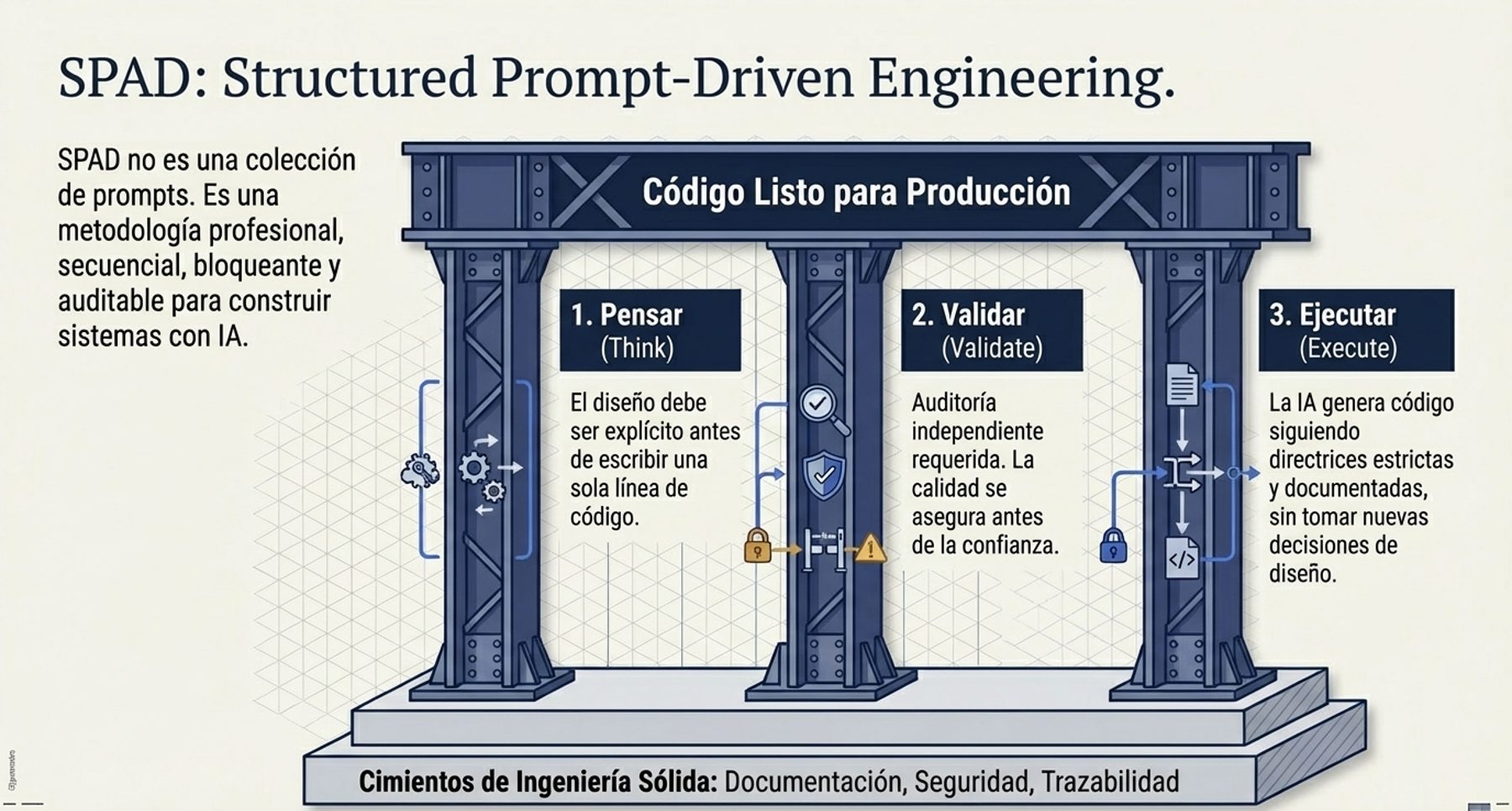
Why it matters. AI generates plausible code at great speed. Without structure, that speed turns into design decisions that nobody has taken consciously, insufficient tests, vulnerabilities introduced silently and technical debt that is hard to see. SPAD keeps the speed where it adds value and puts control where it is needed: in decisions, in reviews and in evidence.
SPAD is an independent method, not a supporting methodology of SEVEN-G. The two connect at a single point, SEVEN-G document 53: SEVEN-G decides what is built, with what risk and how it is measured; SPAD solves how the software is built when it is built with AI (section 9).
The author's position. SPAD does not promise savings or productivity figures: each organisation measures its own (document 08).
| Use | What the company does | What it relies on |
|---|---|---|
| 1. Build its own software with AI | Its team works in phases, with reviewed artefacts, independent review and human validation of every output. | Roles (section 4), main cycle (section 5) and validation policy (section 7). |
| 2. Demand as a client | If it knows how software is built with AI, it can ask its suppliers and integrators to pass the productivity gain on to the company: lower cost, or more scope for the same price. | What SPAD already defines and the company can ask to receive (next table). |
What it can ask of a supplier or an integrator, without going beyond what SPAD already defines:
| What to ask for | What it gives you | Where SPAD defines it |
|---|---|---|
| The artefact of each phase: plan, plan review, test strategy, code review and version record. | Seeing that the design was decided before the code and that each phase was reviewed. | Section 5 and documents 01 and 07. |
| The model record of each artefact: provider, model, version, instruction and contexts. | Knowing which part of the work the AI did and with which tool. | Document 02, section 4.1. |
| The human validation record and the violation log. | Checking that a person approved what is delivered and seeing which AI responses were discarded. | Document 02, sections 4.2 and 4.3, and document 03. |
| The verdicts of each review (GO, GO with changes, NO-GO). | Seeing where the work went back and why. | Document 01, section 5. |
| The process metrics: time per phase, iterations to GO, escaped defects and rework after delivery. | Knowing the real effort of the work and discussing price and scope with the supplier's own data. | Document 08, section 5. |
| The self-assessment of conformity. | Receiving the work with a shared definition of "done". | Section 8 and document 08. |
Why it matters. AI changes what it costs to build software. If the company does not know how software is built with AI, it cannot know whether that change reaches its invoice or stays with the supplier. SPAD gives it a common language and specific evidence to ask the question. It sets no percentage: it lets the company negotiate with data.
| Symptom | What usually lies behind it | How SPAD addresses it |
|---|---|---|
| The generated code works in the demonstration and fails in production. | Nobody designed the solution: code was requested until it "worked". | The design (PLAN) is mandatory, explicit and reviewed before any code is written. |
| Nobody knows why the system is built the way it is. | The design decisions were taken by the AI inside the code. | Every decision is documented in the plan; the AI that builds cannot take design decisions. |
| Tests are scarce or only test the easy case. | Tests are written at the end, if there is time left. | The test strategy and its minimum coverage are set before building, and a review checks that they are met. |
| Vulnerabilities appear in code that nobody reviewed. | The review was done by the same AI that wrote the code, or was not done at all. | Independent review: the AI that reviews is never the one that builds; sensitive code undergoes a security review. |
| A small change breaks another part of the system. | Fixes are made by rewriting entire modules. | Fixes are minimal, justified and traceable. |
| An audit asks for evidence of the development and none exists. | The work remained in conversations with the AI. | Each phase leaves an artefact with a name, topic and version in a common structure. |
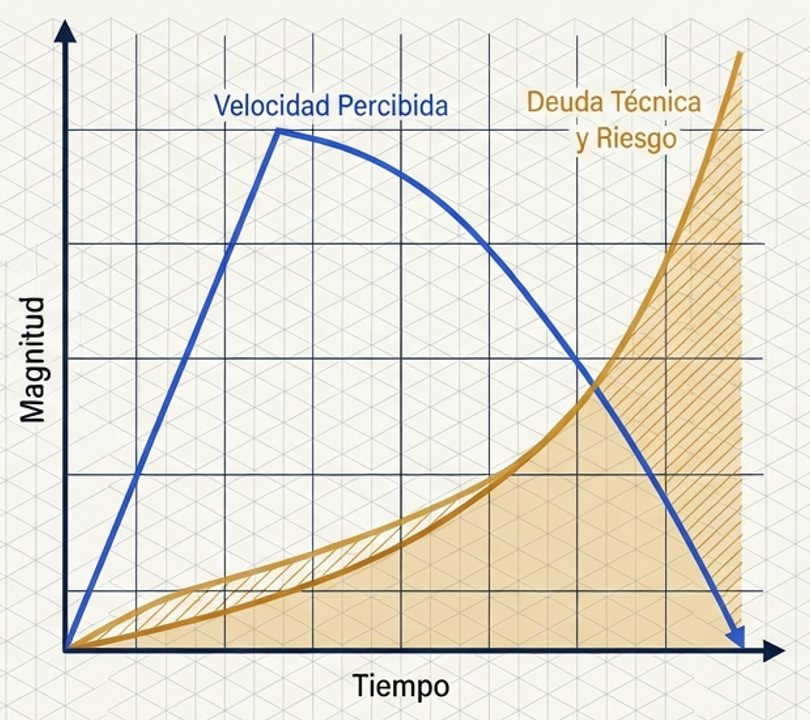
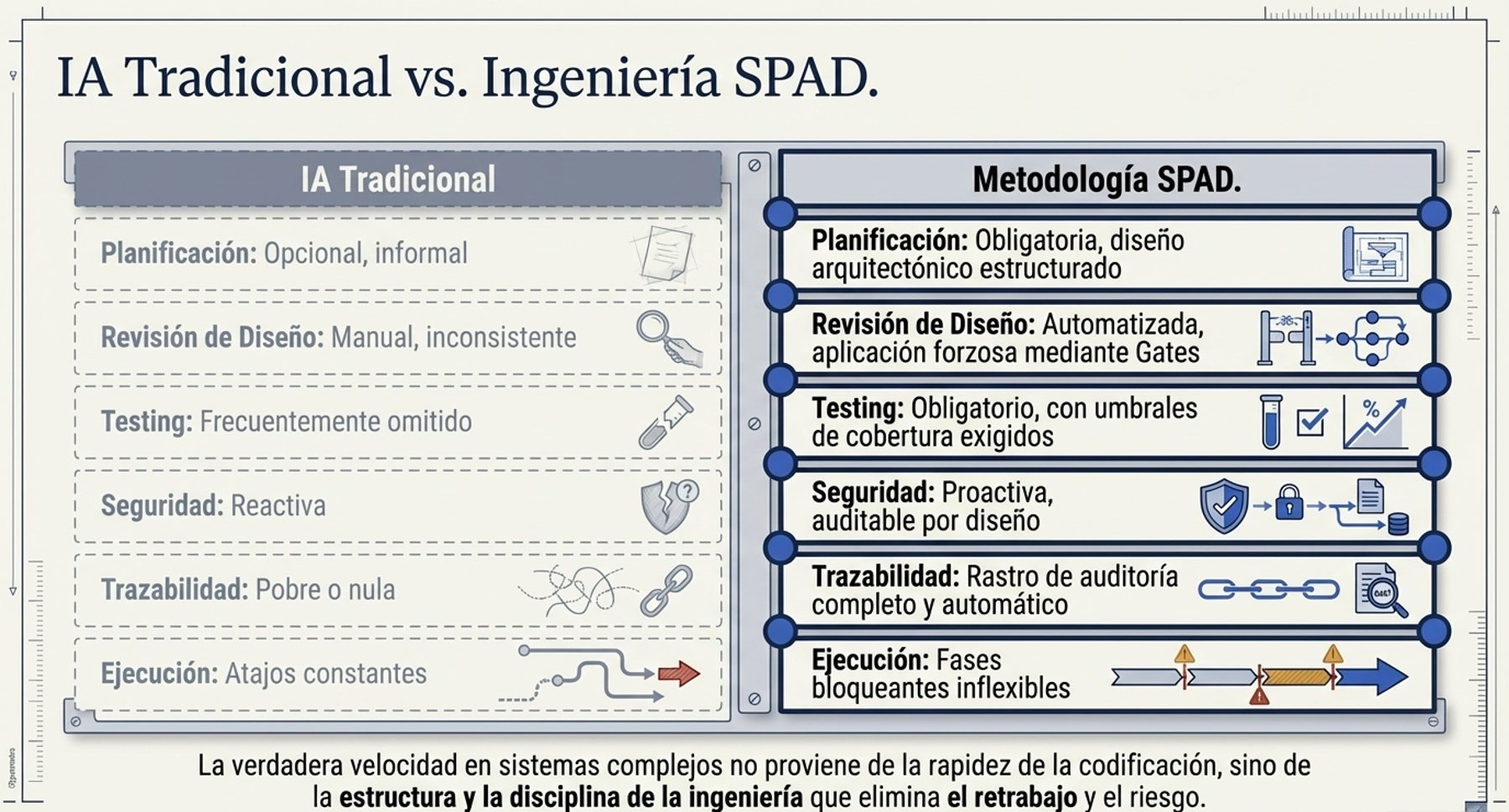
Why it matters. None of these problems is caused by AI: they are problems of method that AI amplifies. With SPAD, quality does not depend on the skill of whoever writes the instructions or on the model of the moment, but on a process that any team can repeat.
In SPAD, compliance with the flow is more important than the apparent quality of the result.
A technically correct AI response that breaks the rules of its phase —for example, a plan that includes code or a review that fixes instead of evaluating— is not used: it is discarded in its entirety and the phase is repeated. The validation priority is:
| Priority | Criterion |
|---|---|
| 1 | Process compliance |
| 2 | Technical correctness |
| 3 | Efficiency |
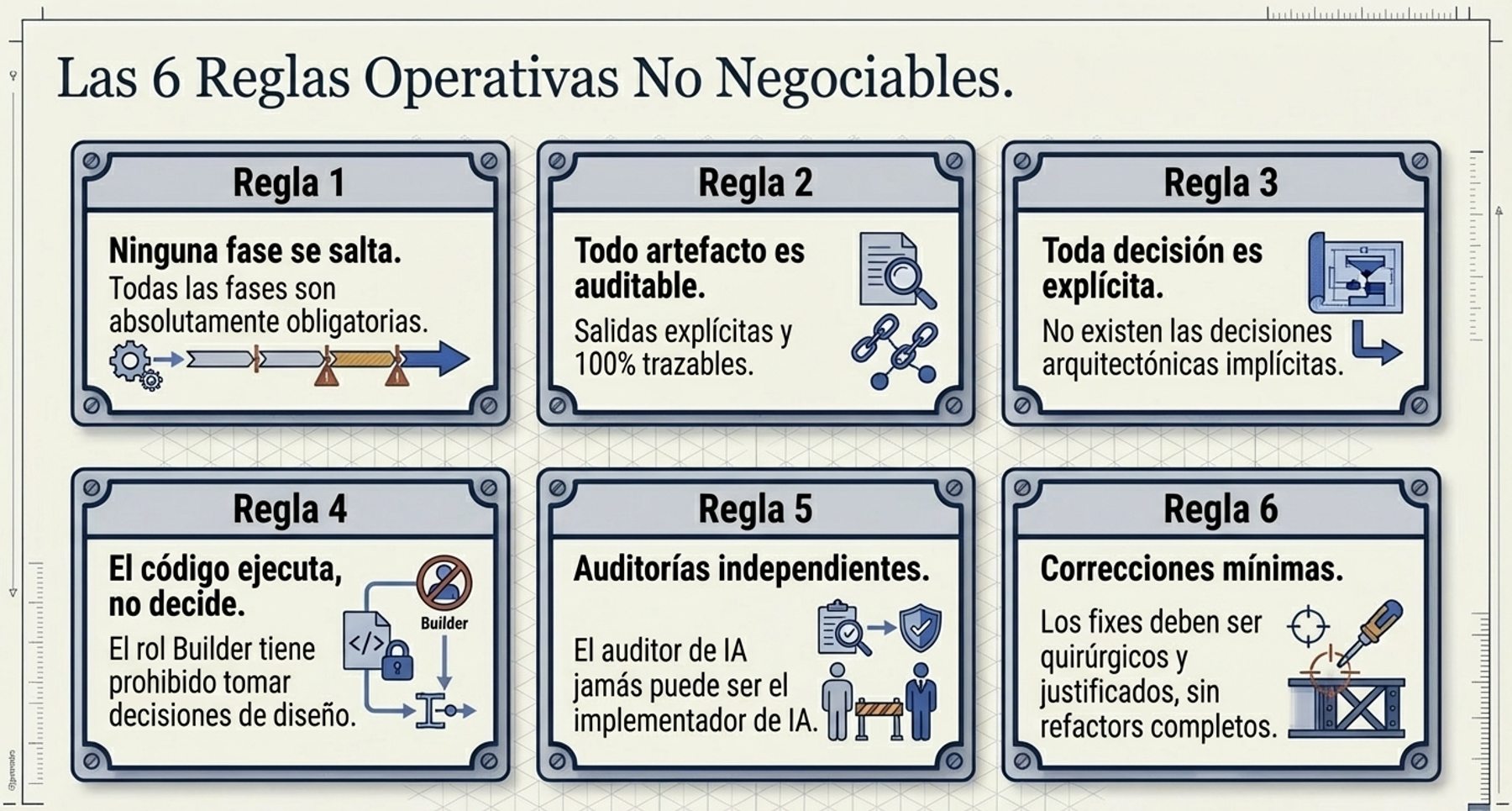
Why it matters. If a response that breaks the rules is accepted "because the code works", the process ceases to exist by the second time. The discipline of discarding and repeating is what makes the artefacts reliable and the traceability real. A valid "no" from a review is worth more than an invalid "yes".
SPAD separates the logical roles from the people and AIs involved. The same AI may take on several roles over the course of a piece of work, but never two roles in the same phase.
| Role | Who | What it does | What it cannot do |
|---|---|---|---|
| Orchestrator | Person | Defines the objective and the context, validates each output and decides whether to advance. Has the final say. | Delegate validation to the AI that produced the output. |
| AI Planner | AI | Designs the architecture and the logic, sets the conventions, the test strategy and the version. | Write code. |
| AI Reviewer | AI other than the builder | Reviews plans, tests and code, and issues a verdict. | Fix what it reviews or approve with known problems. |
| AI Builder | AI | Implements the code and the tests following the approved plan. | Take design decisions. |
| AI Fixer | AI | Applies minimal, justified fixes to the problems detected. | Redesign or extend functionality. |
| AI Analyst and Diagnostic AI | AI | Document legacy code and analyse incidents (legacy and debugging cycles). | Propose the solution instead of the diagnosis. |
The reviewing role is called AI Reviewer so that it is not confused with the SEVEN-G AI Auditor, who is a person.
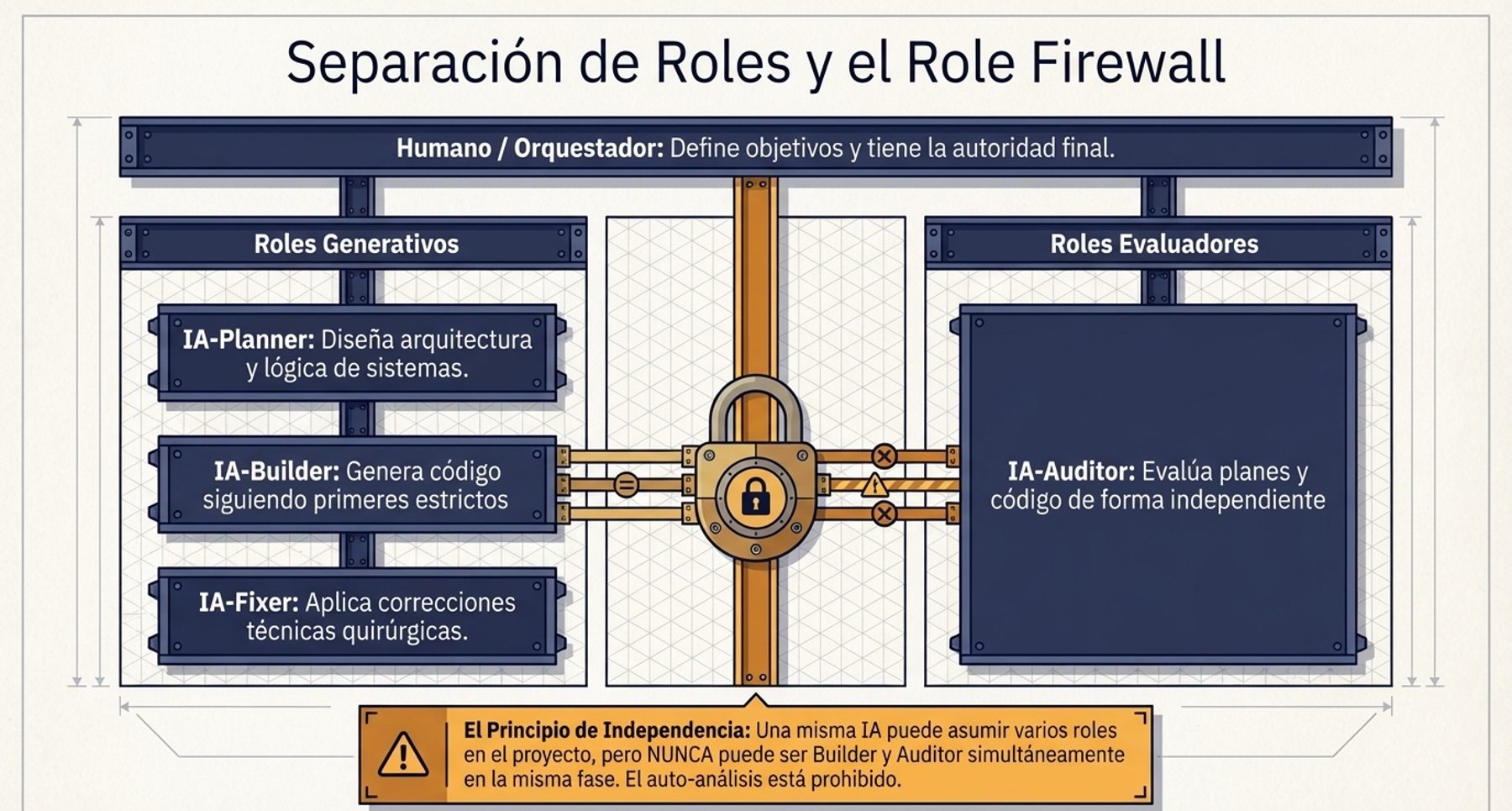
Why it matters. Segregation of duties is a classic control in any serious process: whoever does the work does not approve it. SPAD applies it between artificial intelligences as well and always leaves a person accountable for validation.
The main cycle is used to build a new feature. Each phase has an owner, an input and a mandatory output.
| Phase | Owner | Mandatory output |
|---|---|---|
| 0 · Context and objective | Orchestrator | Description of the problem, scope and constraints. |
| 1 · PLAN | AI Planner | Logical architecture, components and responsibilities, data flows, explicit decisions and known risks. No code. |
| 2 · Plan review (AUDIT_PLAN) | AI Reviewer | Problems detected, recommendations and verdict. Assesses coupling, cohesion, scalability, concurrency, security and observability. |
| 3 · Code primer (CODE_PRIMER) | AI Planner | Project structure, conventions, contracts, strict rules and prohibited anti-patterns. |
| 4 · Test strategy (TEST_STRATEGY) | AI Planner | Test cases, minimum coverage, test types and required test data. |
| 5 · Implementation | AI Builder | Code generated in accordance with the plan and the code primer. |
| 6 · Test implementation | AI Builder | Tests, test data and execution instructions. |
| 7 · Test review (AUDIT_TESTS) | AI Reviewer | Actual versus expected coverage, quality of the tests and edge cases covered. |
| 8 · Code review (AUDIT_CODE) | AI Reviewer | Fidelity to the plan, compliance with the code primer, technical risks and future debt. |
| 9 · Fixes (FIX_PRIMERS) | AI Fixer | For each fix: problem, minimal change, justification and expected impact. |
| 10 · Version management | AI Planner | Version number, change log, breaking changes and migration instructions. |
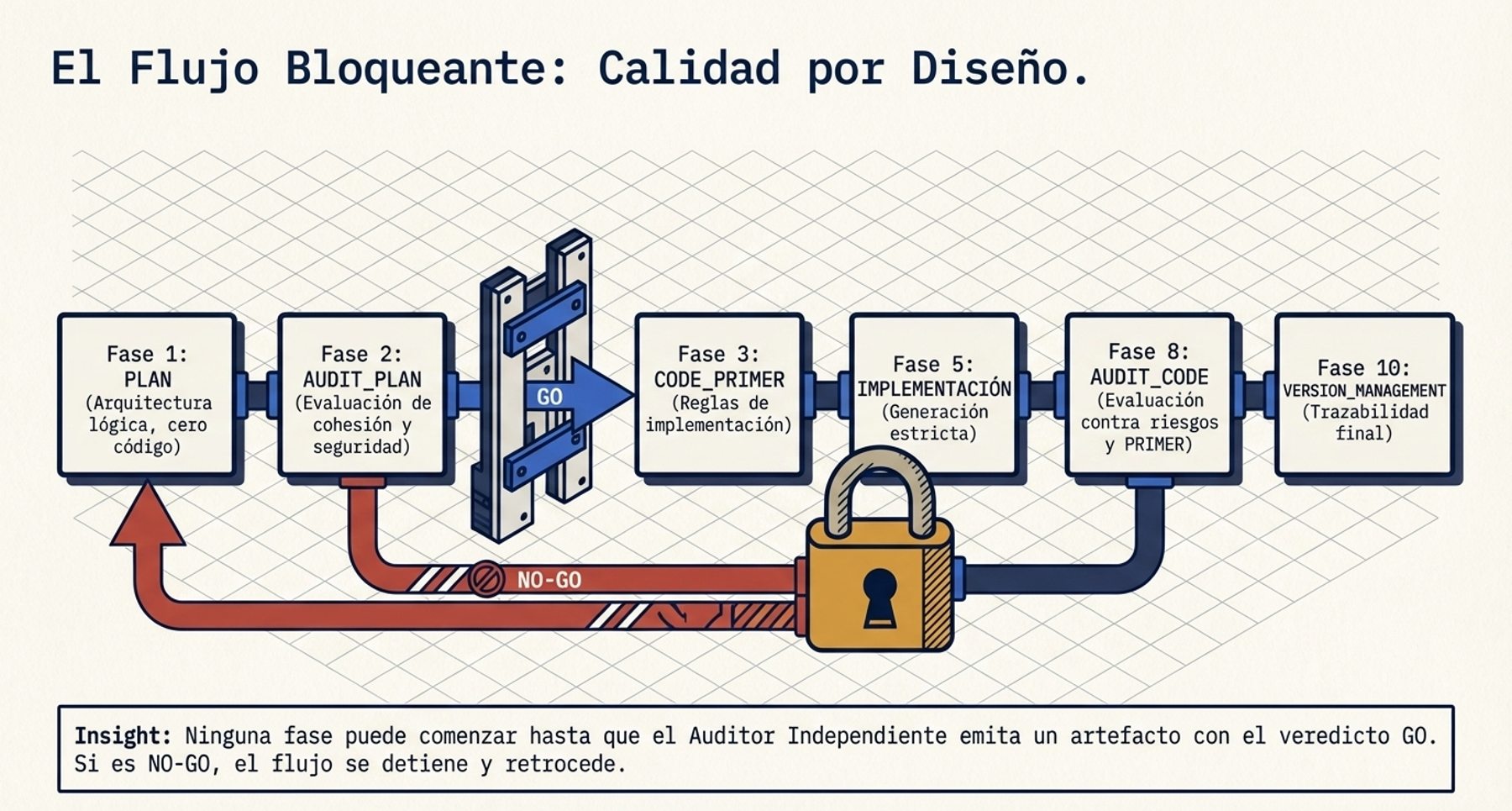
flowchart TD
  A["0 · Context and objective"] --> B["1 · PLAN"]
  B --> C{"2 · Plan review (AUDIT_PLAN)"}
  C -->|"GO"| D["3 · Code primer (CODE_PRIMER)"]
  C -->|"GO WITH CHANGES"| B
  C -->|"NO-GO"| A
  D --> TS["4 · Test strategy (TEST_STRATEGY)"]
  TS --> E["5 · Implementation"]
  E --> TI["6 · Test implementation"]
  TI --> AT{"7 · Test review (AUDIT_TESTS)"}
  AT -->|"NO-GO"| TI
  AT -->|"GO"| F{"8 · Code review (AUDIT_CODE)"}
  F -->|"Problems"| G["9 · Fixes (FIX_PRIMERS)"]
  G --> E
  F -->|"OK"| V["10 · Version management"]
  V --> H["Stable system"]
There are three review verdicts:
| Verdict | Meaning | What happens |
|---|---|---|
| GO | The output complies and work can advance. | Work moves on to the next phase. |
| GO WITH CHANGES | The output is essentially valid but requires adjustments. | Work goes back to the previous phase to incorporate them and is reviewed again. |
| NO-GO | The output has problems that prevent advancing. | Work goes back to the corresponding phase; in the case of the plan, to the context and objective. |
Why it matters. Detecting an architecture error in the plan review costs a conversation; detecting it in production costs an incident, an urgent fix (hotfix) and sometimes a customer's trust. The cycle brings expensive decisions forward to the moment when they are still cheap.
Not all work is a new feature. SPAD defines specific cycles that reuse the same rules:
| Cycle | When it is used | Sequence | Outcome |
|---|---|---|---|
| Legacy | Existing code without sufficient documentation needs to be modified. | Document what exists → analyse the impact of the change → continue with the main cycle. | Current behaviour documented and risks of the change identified before anything is touched. |
| Debugging | A problem appears in production or in development. | Incident analysis → root cause report with a verdict (code, configuration or infrastructure). | If the cause is the code, the main cycle is entered; if not, a configuration or system adjustment. |
| Urgent fix | Critical incident that requires an immediate solution. | Rapid diagnosis → simplified plan → accelerated but mandatory review → implementation with minimal tests → deployment → monitoring → post-mortem. | Solution deployed, post-mortem and, if the fix is provisional, a definitive plan pending. |
| Security | Code that handles sensitive data, authentication or payments. | Security review → classification of findings → fixing of critical and high findings → decision on medium and low ones. | Critical and high findings block deployment; accepted risks are documented. The review takes recognised guides such as the OWASP Top 10 as its reference. |
flowchart LR
  P["Critical incident"] --> D["Rapid diagnosis"]
  D --> H["Simplified plan"]
  H --> A{"Accelerated review"}
  A -->|"NO-GO"| H
  A -->|"GO"| I["Implementation and minimal tests"]
  I --> DEP["Deployment"]
  DEP --> M["Monitoring"]
  M --> PM["Post-mortem"]
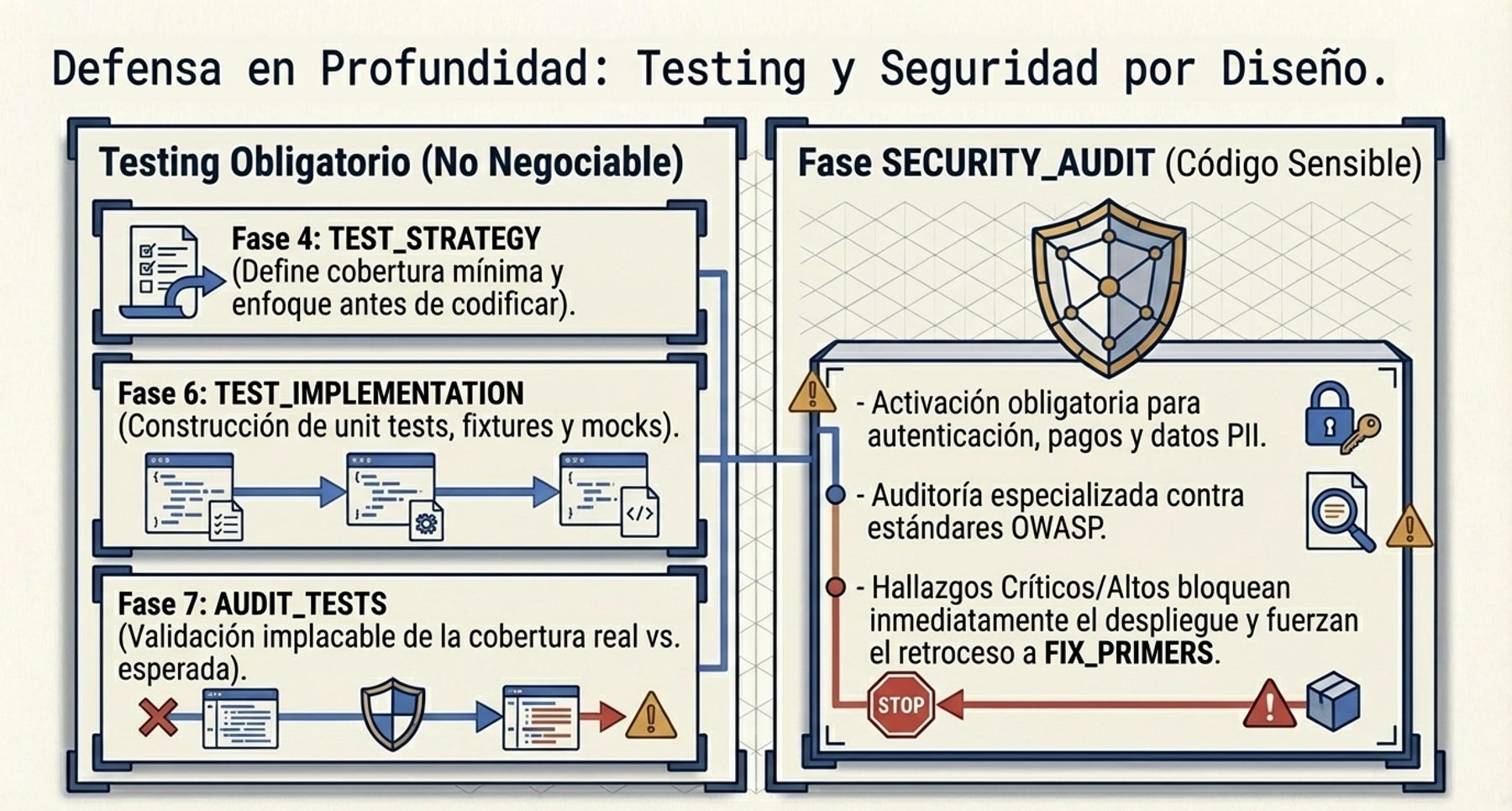
Why it matters. Haste is when controls are most relaxed and when errors do the most damage. SPAD speeds up the phases in an emergency but does not eliminate them: the review and the tests remain mandatory, and the post-mortem turns the incident into learning.
Two contexts are loaded before any phase:
| Context | Content | Illustrative example |
|---|---|---|
| Global | Rules common to all the organisation's projects: where and how artefacts are stored, naming, testing requirements, versioning and general prohibitions. | "No secret is written in the code; every new feature has unit tests." |
| Project | Rules of the specific project: language and technologies, architecture, compliance requirements, business constraints and justified exceptions to the global rules. | "Customer data does not leave the European region; the existing corporate database is used." |
If the global context (GLOBAL_CONTEXT) and the project context (PROJECT_CONTEXT) conflict, the project context prevails, always with a written justification.
Each piece of work is associated with a topic (TOPIC): a short name that groups all its artefacts (plan, reviews, tests, version) in the same folder. In this way, any feature or fix can be reconstructed from start to finish.
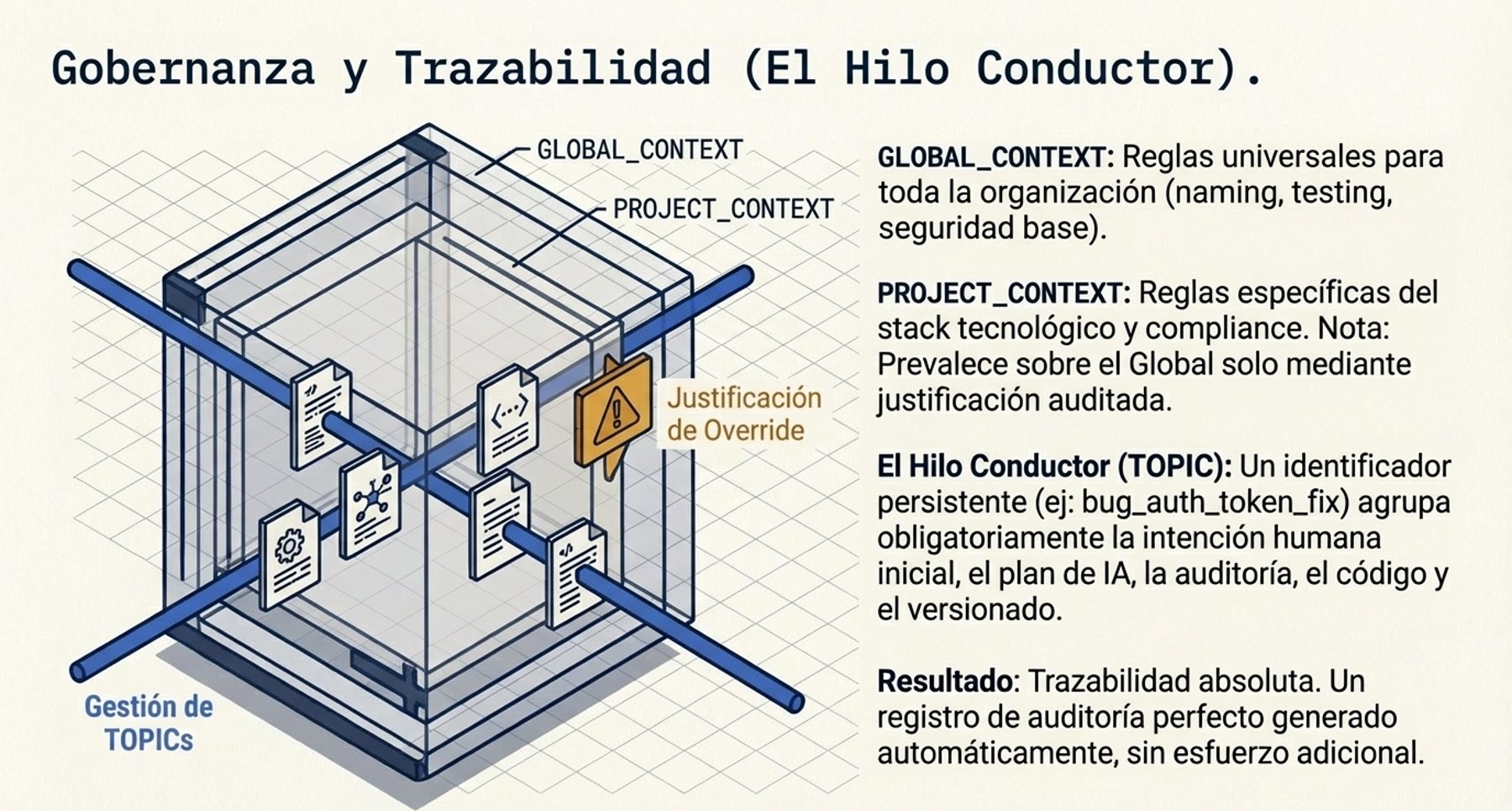
The person orchestrating applies an explicit policy that defines when an AI response is invalid and must be discarded, even if it looks good:
| Cause of invalidation | Example | What is done |
|---|---|---|
| Phase violation | The plan includes code; the review fixes instead of evaluating. | Discard and repeat the phase. |
| Incomplete artefacts | A review without an explicit verdict; a test strategy without minimum coverage. | Discard and repeat the phase. |
| Decisions outside the plan | The implementation adds a component that the plan did not provide for. | Go back to the plan. |
| Implementation without review | Code is generated without an approved plan or after a NO-GO. | Go back to the correct phase and discard the code. |
| Self-approval | "There are three problems, but they are minor: GO." | Immediate discard; it is considered a critical violation. |
A well-founded NO-GO, a detected vulnerability or a failing test do not invalidate a response: they are the process working. If the same violation recurs, the instructions are reinforced; if it persists after several attempts, the model is changed or a person intervenes.
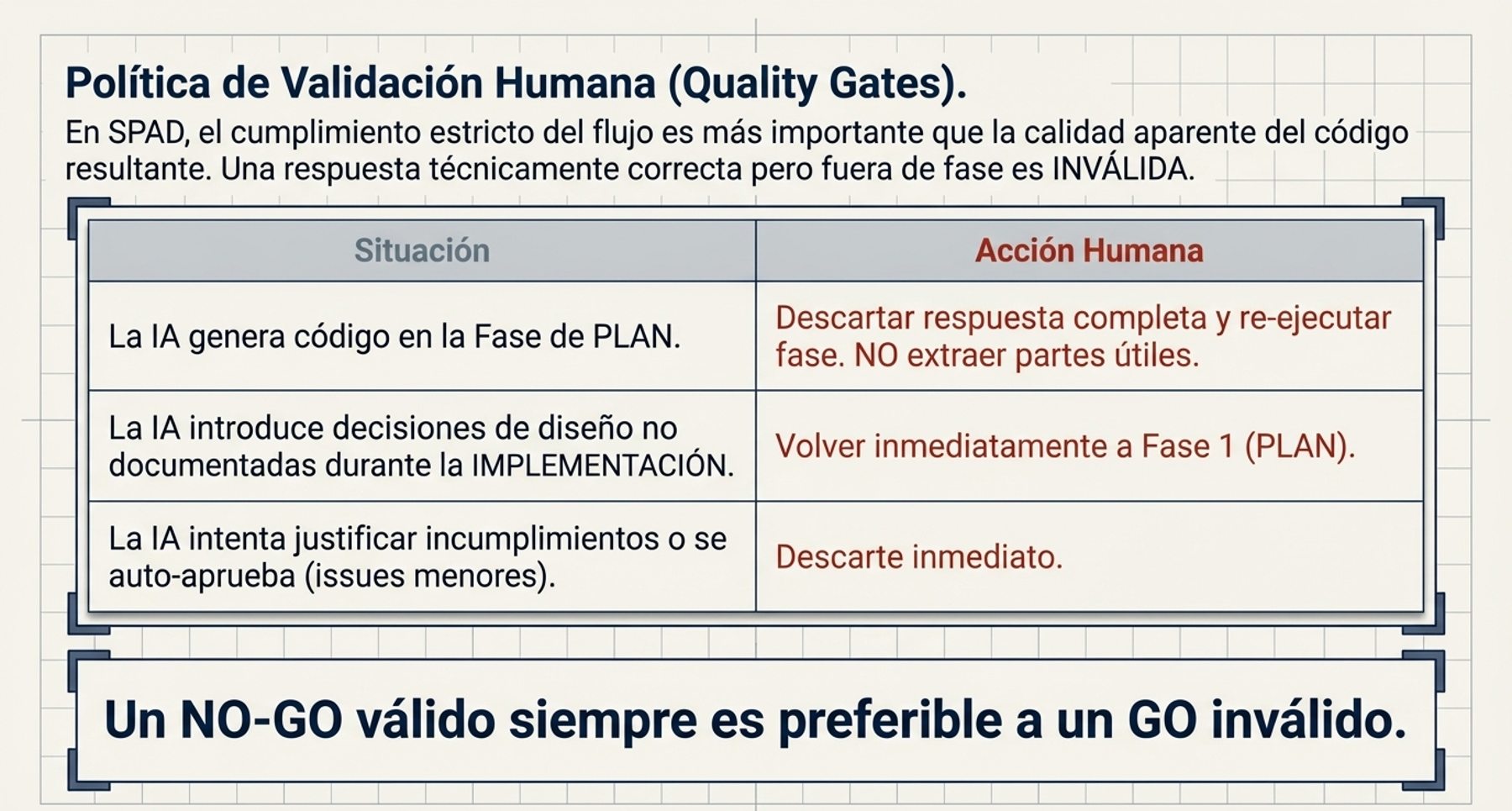
Why it matters. The validation policy is applied by a person, not by the AI. It is the point at which the organisation exercises real control over what is built, and the one that turns a set of good practices into a verifiable method.
An organisation can check whether a system, a project or a team has worked in accordance with SPAD by means of a self-assessment of conformity:
| Aspect | Description |
|---|---|
| What it checks | That decisions were taken before code was written, that each phase left its artefact, that the reviews were independent, that no phase was skipped or merged and that fixes were minimal and traceable. |
| Who carries it out | A person designated by the organisation itself, independent of those who built. |
| Possible outcomes | Approved · Approved with conditions · Rejected. The absence of a mandatory artefact makes it negative. |
| Validity | Twelve months, or until there are significant changes in architecture, scope or decision logic. |
It is not a certification. It is neither issued nor endorsed by its author or any third party, does not attest compliance with any standard and cannot be presented as a certification or as a marketing claim.
Why it matters. The self-assessment gives the organisation a shared definition of "done" and a set of evidence ready for internal or external audits, without creating the false appearance of a seal that nobody has granted.
SPAD and SEVEN-G solve different problems, at different levels. SEVEN-G governs the company's AI; SPAD, building software with AI. SPAD is not part of SEVEN-G. The only bridge between the two is SEVEN-G document 53 and its template P66:
| Aspect | SEVEN-G | SPAD |
|---|---|---|
| Subject | The complete AI use case and the company's portfolio. | The development of a solution's software. |
| Question | Is it worth it, with what risk and with what measured value? | Is it well built, tested and documented? |
| Decisions | Decision gates taken by accountable people. | Technical review verdicts validated by the orchestrator. |
| Where it applies | Throughout the lifecycle, from idea to retirement. | Wherever software is built with AI. If the company uses SEVEN-G, mainly in its design and delivery phases. |
Rules for working together:
The detailed mapping of phases, roles, evidence and requirements is in SEVEN-G 53 · Building solutions with AI.
Why it matters. A board does not need to know how an architecture plan is reviewed, but it does need to know that there is a method that does so and that leaves evidence. SPAD is that method for the build; SEVEN-G, if the company uses it, is the one that decides whether the use case goes ahead.
| Situation | Recommendation |
|---|---|
| Systems in production with customers, sensitive data, money or decisions about people. | Highly recommended, with the complete main cycle and a security review. |
| Sectors with audit or compliance requirements (finance, insurance, health, public sector). | Highly recommended. |
| Projects with several developers, significant technical debt or a need for traceability. | Recommended. |
| Internal tools with business impact or prototypes that aspire to production. | Useful, in a reduced version. |
| Throwaway prototypes, programs for personal use or pure research. | Unnecessary: the cost of the process exceeds its benefit. |
At first, SPAD makes work slower while the team learns the phases. The hypothesis is that, with practice, it reduces rework, incidents and technical debt; no improvement figure is claimed: each organisation must measure it against its own starting position.
SPAD is under construction as a public methodology: the library exists in full in Spanish and English, and it will grow with tools and application cases. This page is its entry point.
| Document | Content | When to read it |
|---|---|---|
| document 00 · What SPAD is and how it helps | Presentation of the method. | First. |
| document 01 · Operating guide | Phases 0–10, roles, verdicts and reduced version. | Before applying SPAD for the first time. |
| document 02 · Contexts, topics and artefact register | What is loaded before working and what is recorded for each artefact. | When preparing the organisation. |
| document 03 · Validation policy | When an AI response is discarded. | Whoever orchestrates, always. |
| document 04 · Complementary cycles | Legacy, debugging, urgent fixes and security. | When the work is not a new feature. |
| document 05 · Systems that include AI | Behaviour evaluation and agents. | When the solution has AI in production. |
| document 06 · Instructions by phase | Reference text of each instruction. | When configuring the tools. |
| document 07 · Input and output contracts | Mandatory structure of each artefact. | When automating validation. |
| document 08 · Self-assessment and metrics | How to check conformity and measure the process. | When closing a piece of work and when reviewing the method. |
| document 09 · Guided example: building a personal virtual assistant | SPAD applied top-down to a complete case: define the agent, design what it needs and build it one capability at a time. Under review. | To see the method in a case before applying it. |
SPAD is published under the same conditions as SEVEN-G: the content under a Creative Commons Attribution 4.0 International (CC BY 4.0) licence and the code under the MIT licence. It may be used, adapted and extended, including for commercial purposes, provided that authorship is visibly credited: SPAD · Fernando García Varela. The full conditions of use and citation are those of SEVEN-G 93 · Licence, use by third parties and citation.
There is no SPAD certification and use of the name does not imply endorsement by the author. A public declaration of conformity with SPAD may only be presented as a self-assessment (section 8).
| Version | Date | Changes |
|---|---|---|
| 0.4 | 18-11-2026 | Section 11 links document 09, a guided example of a personal virtual assistant (under review). |
| 0.3 | 14-11-2026 | Positioning: SPAD solves one specific problem, building software with AI, and it is neither a framework for the company's AI governance nor a supporting methodology of SEVEN-G. New subsection "What it does for a company" (the author's position, without figures): building with method and demanding as a client that productivity reaches the company. SEVEN-G document 53 remains the only bridge (section 9). |
| 0.2 | 19-09-2026 | Complete library (documents 01–08) linked from section 11; the diagnostic role is named "Diagnostic AI". |
| 0.1 | 18-09-2026 | First version of the entry page, based on the SPAD working documents: properties of the framework, problem it solves, validation principle, roles, main cycle and verdicts, legacy, debugging, urgent fix and security cycles, contexts, topics, validation policy, self-assessment of conformity, relationship with SEVEN-G and when to use it. |
Links to the official or primary source, checked before publication. Always verify the version in force on the date of use.